

Adapt or Just Automate? Why Your AI Strategy is Already Outdated.
The Quick Take: When Efficiency Is Mistaken for Intelligence

Surabaya, StartFriday.Asia - The Quick Take: Most brands are confusing efficiency with intelligence. While automation handles repetitive tasks, True AI is defined by adaptation—the ability to learn from data and pivot behavior in real-time. To lead in the next era of marketing, brands must move beyond static "bots" and build goal-directed, adaptive systems. Most brands today believe they are becoming “AI-driven,” when in reality, they are only becoming faster.
Automation has helped businesses execute repetitive tasks at scale, but speed alone does not equal intelligence. True Artificial Intelligence is not defined by how quickly a system responds, but by its ability to adapt—learning from data, adjusting behavior, and evolving decisions in real time. As markets become more volatile and customer behavior more unpredictable, static systems begin to show their limits. To lead the next era of marketing, brands must stop relying on rule-based bots and start building goal-oriented, adaptive AI systems that learn continuously from outcomes, not just inputs.
The AI Misconception: Why Speed Isn’t Smart
The rush to adopt AI has created a widespread misunderstanding among business leaders. Many systems labeled as “AI” today are, in fact, advanced automation tools. Automation operates on fixed logic. When the same input consistently produces the same output, the system is efficient—but it does not learn. These systems break down the moment conditions change, customer behavior shifts, or unexpected variables appear.
True intelligence, by contrast, is adaptive. An intelligent system evaluates the consequences of its actions, incorporates new data, and modifies future behavior accordingly. As Charles Darwin famously observed, intelligence is not measured by strength or speed, but by the ability to change. In marketing, this distinction determines whether a brand merely operates—or truly evolves.
Read More: Artificial Intelligence Ubah Segalanya: Inilah Rahasia Product Branding 2026
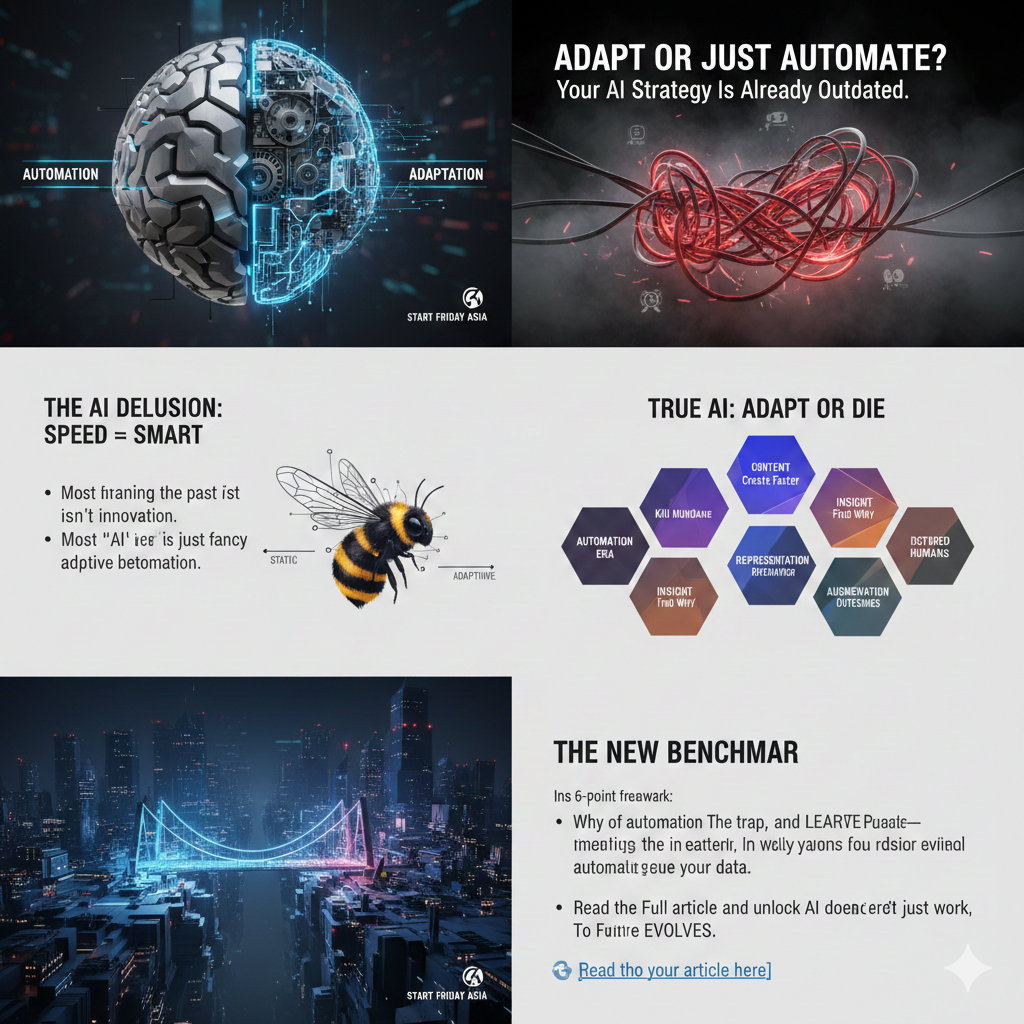
For brands to succeed, they must move beyond the hype and adopt a practical framework for AI focused on creating value, not just mimicking human behaviour
Automation vs. Adaptive AI: Understanding the Difference
Feature Automation (Static) Adaptive AI (Intelligent) Core Logic Rule-based (If This, Then That) Learning-based (Neural Networks) Adaptability Low; fails when conditions change High; self-improves via data Outcome Consistency & Scalability Prediction & Evolution Best For Data entry, scheduling, basic chatStrategy, personalization, forecasting
A Practical Framework: The Six Core Applications of AI
Instead of chasing hype, Start Friday Asia advocates for a framework centered on Creative Transformation. Most business friction can be solved by one of these six core functions:
Task Automation: Freeing humans from mundane, repetitive work (e.g., RPA).
Content Generation: Accelerating creativity with GenAI (text, video, design).
Human Representation: Simulating behavior to predict customer shifts.
Insight Extraction: Finding meaningful patterns in massive datasets.
Decision Making: Using algorithms to forecast consequences and optimize moves.
Human Augmentation: Extending capabilities via digital twins or BCI.
How to Build a Culture of Adaptation
To move from "using tools" to "building advantage," your strategy must evolve. Here is how to execute an adaptive AI strategy:
Define the Friction, Not the Tech
Don't start with "How do we use ChatGPT?" Start with the high-value problem in your operations—from supply chain gaps to customer experience friction.
Distinguish Between Efficiency and Moats
Use automation for immediate ROI. But invest in adaptive AI to build a competitive moat—a system that evolves so deeply with your data that competitors cannot simply "copy and paste" your success.
Kill the Silos
Successful AI is not an IT project. It requires a "Growth Mindset" where AI talent collaborates with domain experts in marketing, commerce, and technology.
Trust as Your Greatest Asset
In an algorithmic world, Responsible AI is your most durable competitive advantage. Embed ethical protocols and data transparency into your system from Day One. Trust isn't just a legal checkbox; it's the foundation of your brand's future.
The future of marketing belongs to brands that stop mimicking human behavior and start harnessing adaptive behavior. The goal isn't to build a machine that acts like us—it’s to build a system that understands and responds to the world in real-time.
Stop automating the past. Start adapting to the future.
Read More: Artificial Intelligence (AI) Makes Learning at TRIMURTI More Fun and Flexible
